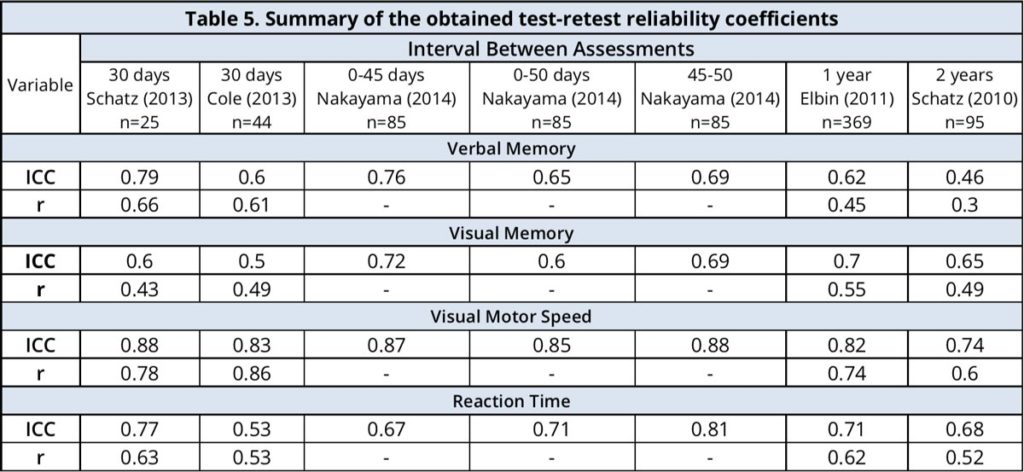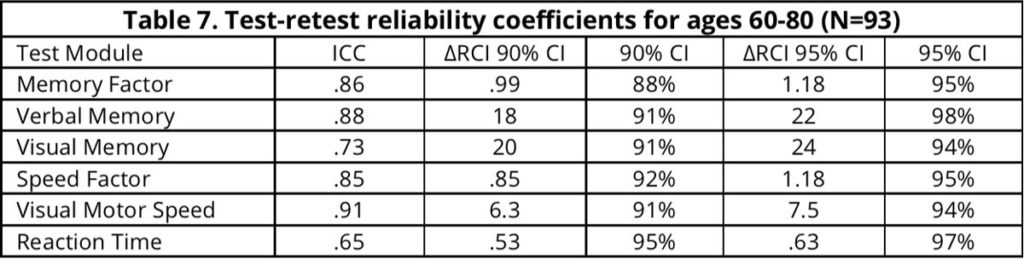
ImPACT® Reliability and Validity

Measurement of Symptoms Following Sports-related Concussion: Reliability and Normative Data for the Post-Concussion Symptom Scale

  • Authors: Lovell, Iverson, Collins, Podell, Johnston, Pardini, Pardini, Norwig, Maroon
  • Publication: Applied Neuropsychology
  • Date: 2006-05-15

Validity of ImPACT for Measuring Attention and Processing Speed Following Sports-Related Concussion

  • Authors: Iverson, Lovell, Collins
  • Publication: Journal of Clinical and Experimental Neuropsychology
  • Date: 2006-05-15

Abstract:
The purpose of this study was to examine the validity of ImPACT, a computerized neuropsychological test battery, for measuring attention and processing speed in athletes with concussions. This was accomplished by comparing the computerized testing to a traditional neuropsychological measure, the Symbol Digit Modalities Test. Participants were 72 amateur athletes who were seen within 21 days of sustaining a sports-related concussion. As predicted, the SDMT correlated most highly with the Processing Speed and Reaction Time composites from ImPACT.

High School Concussions in the 2008-2009 Academic Year

  • Authors: William P. Meehan III, MD, Pierre d'Hemecourt, MD, R. Dawn Comstock, PhD
  • Publication: The American Journal of Sports Medicine
  • Date: 2011-06-02

Abstract:
Background: An estimated 136 000 concussions occur per academic year in high schools alone. The effects of repetitive concussions and the potential for catastrophic injury have made concussion an injury of significant concern for young athletes. Purpose: The objective of this study was to describe the mechanism of injury, symptoms, and management of sport-related concussions using the High School Reporting Information Online (HS RIO) surveillance system. Study Design: Descriptive epidemiology study. Methods: All concussions recorded by HS RIO during the 2008-2009 academic year were included. Analyses were performed using SPSS software. Chi-square analysis was performed for all categorical variables. Statistical significance was considered for P.05. Results: A total of 544 concussions were recorded. The most common mechanism (76.2%) was contact with another player, usually a head-to-head collision (52.7%). Headache was experienced in 93.4%; 4.6% lost consciousness. Most (83.4%) had resolution of their symptoms within 1 week. Symptoms lasted longer than 1 month in 1.5%. Computerized neuropsychological testing was used in 25.7% of concussions. When neuropsychological testing was used, athletes were less likely to return to play within 1 week than those for whom it was not used (13.6% vs 32.9%; P.01). Athletes who had neuropsychological testing appeared less likely to return to play on the same day (0.8% vs 4.2%; P = .056). A greater proportion of injured, nonfootball athletes had computerized neuropsychological testing than injured football players (23% vs 32%; P = .02) Conclusion: When computerized neuropsychological testing is used, high school athletes are less likely to be returned to play within 1 week of their injury. Concussed football players are less likely to have computerized neuropsychological testing than those participating in other sports. Loss of consciousness is relatively uncommon among high school athletes who sustain a sport-related concussion. The most common mechanism is contact with another player. Some athletes (1.5%) report symptoms lasting longer than 1 month. Keywords: concussion; sport-related concussion; mild traumatic brain injury; athletic injury; sports

Identifying Neurocognitive Deficits

  • Authors: Danny G. Thomas, MD, MPH, Michael W. Collins, PhD, Richard A. Saladino, MD, Virginia Frank,
  • Publication: Academic Emergency Medicine 2011
  • Date: 2011-06-02

Abstract:
Objectives: This study of concussed adolescents sought to determine if a computer-based neurocognitive assessment (Immediate Postconcussion Assessment and Cognitive Test [ImPACT]) performed on patients who present to the emergency department (ED) immediately following head injury would correlate with assessments performed 3 to 10 days postinjury and if ED neurocognitive testing would detect differences in concussion severity that clinical grading scales could not. Methods: A prospective cohort sample of patients 11 to 17 years of age presenting to the ED within 12 hours of a head injury were evaluated using two traditional concussion grading scales and neurocognitive testing. ED neurocognitive scores were compared to follow-up scores obtained at least 3 days postinjury. Postconcussive symptoms, outcomes, and complications were assessed via telephone followup for all subjects. Results: Sixty patients completed phone follow-up. Thirty-six patients (60%) completed follow-up testing a median of 6 days postinjury. Traditional concussion grading did not correlate with neurocognitive deficits detected in the ED or at follow-up. For the neurocognitive domains of verbal memory, processing speed, and reaction time, there was a significant correlation between ED and follow-up scores trending toward clinical improvement. By 2 weeks postinjury, 23 patients (41%) had not returned to normal activity. At 6 weeks, six patients (10%) still had not returned to normal activity. Conclusions: Immediate assessment in the ED can predict neurocognitive deficits seen in follow-up and may be potentially useful to individualize management or test therapeutic interventions. Neurocognitive assessment in the ED detected deficits that clinical grading could not and correlated with deficits at follow-up.

Neurocognitive and Symptom Predictors of Recovery

  • Authors: Brian Lau, BS, Mark R. Lovell, PhD, Michael W. Collins, PhD, Jamie Pardini, PhD
  • Publication: Clin J Sport Med Volume 0, Number 0, Month 2009
  • Date: 2011-06-02

Abstract:
Objectives: The purpose of this study was to identify specific symptom and neuropsychological test patterns that might serve as prognostic indicators of recovery in concussed high school football players. The recently proposed simple versus complex concussion classification was examined and specific symptom clusters were identified. Design: Case–control study. Setting: High school football. Participants: Subjects were 108 recently concussed male high school football athletes between the ages of 13 and 19 (mean = 16.01) years. Assessment of Risk Factors: Participants were evaluated by utilizing the Immediate Postconcussion Assessment and Cognitive Testing computer-based neurocognitive test battery at before injury and within an average of 2.23 days of injury. All athletes were followed until they met criteria for clinical recovery. Main Outcome Measures: Symptom ratings and neurocognitive test performance. Results: Both neurocognitive test results and self-reported symptom data had prognostic value in determining time to clinical recovery. Self-reported cognitive decline, Immediate Postconcussion Assessment and Cognitive Testing reaction time, and migraine headache symptoms were associated with longer time to clinical recovery. Overall, these difficulties were predictive of concussions that were retrospectively classified as complex. Conclusions: Specific symptom clusters and neurocognitive test results may have predictive value to classifying and managing concussions. Key Words: concussion, complex, neurocognitive, symptoms, simple

Sensitivity and Specificity of Subacute

  • Authors: Brian C. Lau, BS, Michael W. Collins, PhD, Mark R. Lovell, PhD
  • Publication: The American Journal of Sports Medicine
  • Date: 2011-06-02

Abstract:
Background: Concussions affect an estimated 136 000 high school athletes yearly. Computerized neurocognitive testing has been shown to be appropriately sensitive and specific in diagnosing concussions, but no studies have assessed its utility to predict length of recovery. Determining prognosis during subacute recovery after sports concussion will help clinicians more confidently address return-to-play and academic decisions. Purpose: To quantify the prognostic ability of computerized neurocognitive testing in combination with symptoms during the subacute recovery phase from sports-related concussion. Study Design: Cohort study (prognosis); Level of evidence, 2. Methods: In sum, 108 male high school football athletes completed a computer-based neurocognitive test battery within 2.23 days of injury and were followed until returned to play as set by international guidelines. Athletes were grouped into protracted recovery (.14 days; n, 50) or short-recovery (14 days; n, 58). Separate discriminant function analyses were performed using total symptom score on Post-Concussion Symptom Scale, symptom clusters (migraine, cognitive, sleep, neuropsychiatric), and Immediate Postconcussion Assessment and Cognitive Testing neurocognitive scores (verbal memory, visual memory, reaction time, processing speed). Results: Multiple discriminant function analyses revealed that the combination of 4 symptom clusters and 4 neurocognitive composite scores had the highest sensitivity (65.22%), specificity (80.36%), positive predictive value (73.17%), and negative predictive value (73.80%) in predicting protracted recovery. Discriminant function analyses of total symptoms on the Post-Concussion Symptom Scale alone had a sensitivity of 40.81%; specificity, 79.31%; positive predictive value, 62.50%; and negative predictive value, 61.33%. The 4 symptom clusters alone discriminant function analyses had a sensitivity of 46.94%; specificity, 77.20%; positive predictive value, 63.90%; and negative predictive value, 62.86%. Discriminant function analyses of the 4 computerized neurocognitive scores alone had a sensitivity of 53.20%; specificity, 75.44%; positive predictive value, 64.10%; and negative predictive value, 66.15%. Conclusion: The use of computerized neurocognitive testing in conjunction with symptom clusters results improves sensitivity, specificity, positive predictive value, and negative predictive value of predicting protracted recovery compared with each used alone. There is also a net increase in sensitivity of 24.41% when using neurocognitive testing and symptom clusters together compared with using total symptoms on Post-Concussion Symptom Scale alone. Keywords: concussion; prognosis; symptoms; neurocognitive testing

The Value Added of Neurocognitive Testing After Sports-Related Concussion

  • Authors: Van Kampen, Lovell, Pardini, Collins, Fu
  • Publication: The American Journal of Sports Medicine
  • Date: 2006-06-01

Abstract:
Neurocogntive testing has been endorsed as a 'cornerstone' of concussion management by recent Vienna and Prague meetings of the Concussion In Sport Group. Neurocognitive testing is important given the potential unreliability of athlete self-report after injury. Relying only on athletes' reports of symptoms may result in premature return of athletes to contact sport, potentially exposing them to additional injury.

ImPACT Normative Data for Children (Ages 11-14)

  • Authors: Lovell, Collins, Maroon
  • Publication: The ImPACT Test
  • Date: 2006-05-18

Abstract:
Normative Data for the ImPACT Composite Scores A sample of 205 elementary, junior high, and high school students was initially used for this project. Three of these subjects had incomplete test data and were subsequently dropped from the normative sample. The current normative sample consists of 102 boys and 100 girls between the ages of 11 and 14. Multiple analysis of variance (MANOVA) was performed to allow an analysis of performance differences between gender and age across multiple neuropsychological domains.

No Cumulative Effects for One or Two Previous Concussions

  • Authors: Iverson, Brooks, Collins, Lovell
  • Publication: British Journal of Sports Medicine
  • Date: 2006-05-15

Recovery From Sports Concussion in High School and Collegiate Athletes

  • Authors: McClincey, Lovell, Collins, Pardini
  • Publication: Brain Injury
  • Date: 2006-05-15

Abstract:
Neuropsychological testing is a variable tool in concussion diagnosis and management. ImPACT, a computerized neuropsychological testing program, consists of eight cognitive tasks and a 21-item symptom inventory. ImPACT was used to examine the cognitive performance of 104 concussed athletes at baseline, 2, 7, and 14 days post-injury. Dependent measures included composite scores from the ImPACT computerized test battery, as well as a total symptom score from the Post-Concussion Symptom Scale.

Tracking Neuropsychological Recory Following Concussion In Sportsve

  • Authors: Iverson, Brooks, Collins, Lovell
  • Publication: Brain Injury
  • Date: 2006-05-15

Sensitivity and Specificity of the ImPACT Test Battery for Concussion in Athletes

  • Authors: Schatz, Pardini, Lovell, Collins, Podell
  • Publication: Archives of Clinical Neuropsychology
  • Date: 2005-08-03

Abstract:
This study explored the diagnostic utility of the composite scores of Immediate Post-Concussion Assessment and Cognitive Testing and Post Concussion Symptom Scale scores. Recently concussed high school athletes were tested within 72h of sustaining a concussion, and data were compared to non-concussed high school athletes with no history of concussion.

Athlete Concussion Management Guidelines Using Functional Magnetic Resonance Imaging

  • Authors: Lovell, Collins, Fu, Stump
  • Publication: Orthopaedic Technology Review
  • Date: 2004-01-01

Grade 1 or 'Ding' Concussions in High School Athletes

  • Authors: Lovell, Collins, Iverson, Johnston, Bradley
  • Publication: American Journal of Sports Medicine
  • Date: 2004-01-01

Abstract:
Recent concussion management guidelines have suggested that athletes with mild (grade 1) concussions may be returned to play if asymptomatic for 15 minutes. The purpose of this study was to assess the utility of a current concussion management guideline in classifying and managing mild concussion. Forty-three high school athletes completed neuropsychological test performance and symptom ratings prior to the season and at two times during the 1st week following mild concussion.

New Developments in the Management of Sports Concussion

  • Authors: Collins, Stump, Lovell
  • Publication: Current Opinion in Orthopaedics
  • Date: 2004-01-01

Interpreting Change on ImPACT Following Sports Concussion

  • Authors: Iverson, Lovell, Collins
  • Publication: The Clinical Neuropsychologist
  • Date: 2003-05-01

Abstract:
The purpose of this study was to examine the psychometric characteristics of Version 2.0 of ImPACT. The focus was on the stability of the test scores and the calculation of reliable change confidence intervals for the test-retest difference scores. A sample of 56 nonconcussed adolescents and young adults completed the test battery on two occasions. Test-retest coefficients, reliable change difference scores, and confidence intervals for measurement error are provided. These reliable change parameters were applied to a second sample of 41 concussed amateur athletes who were tested preseason and within 72 hr of injury. Applying these confidence intervals allows more precise determinations of deterioration, improvement, and recovery in the initial days following concussion.

Construct Validity of ImPACT in Athletes with Concussion

  • Authors: Iverson, Franzen, Lovell, Collins
  • Publication: Presented at the National Academy of Neuropsychologist's Annual Meeting
  • Date: 2003-01-01

Abstract:
The purpose of this study was to examine the convergenet and divergent validity of computerized neuropsychological testing in a sample of athletes with concussion.

Differential Sensitivity of Symptoms and Neuropsychological Testing Following Sports Related Concussion

  • Authors: Lovell, Collins, Bradley, Van Kampen, Moritz, McClincey
  • Publication: British Journal of Sports Medicine
  • Date: 2003-01-01

Recovery From Mild Concussion in High School Athletes

  • Authors: Lovell, Collins, Iverson, Field, Maroon, Cantu, Podell, Powell, Belza, Fu
  • Publication: Journal of Neurosurgery
  • Date: 2003-01-01

Abstract:
The objective of this study was to evaluate memory dysfunction and self-report of symptoms in a group of concussed high school athletes utilizing a computerized neuropsychological test battery. Neuropsychological performance prior to and following concussion is compared with the test performance and age-matched comparison group. Potentially important diagnostic markers of concussion severity are discussed and linked to recovery within the first week of injury.

Relationship Between Post-Concussion Headache and Neuropsychological Test Performance in High School Athletes?

  • Authors: Collins, Field, Lovell, Iverson, Johnston, Maroon, Fu
  • Publication: American Journal of Sports Medicine
  • Date: 2003-01-01

Abstract:
The relevance of headache to outcome following sports concussion is poorly understood and no studies exist examining this issue. The current study was conducted to investigate whether post-concussion headaches are associated with neurocognitive deficits and/or presence of other post-concussion symptoms at approximately one-week post injury. Study participants included 110 high school athletes who sustained concussion. Concussed athletes were divided into two groups, those reporting no headache at approximately day 7 post-injury and those reporting headaches. Dependent measures included symptom and neurocognitive test results collected via ImPACT, a computerized neuropsychological test battery.

New Developments in the Management of Sports Concussion

  • Authors: Lovell, Collins
  • Publication: Current Sports Medicine Reports
  • Date: 2002-01-01

Validity of ImPACT for Measuring the Effects of Sports-Related Concussion

  • Authors: x
  • Publication: Archives of Clinical Neuropsychology
  • Date: 2002-01-01

Published Abstracts

ImPACT of Sleep Deprivation on Symptoms and Neurocognitive Performance of Orthopaedic Residents

  • Authors: Rohde, Collins, Lovell, Pardini, Fu
  • Publication: Proceedings of the American Academy of Orthopaedic Surgeons
  • Date: 2006-05-18

Cognitive Recovery Patterns Following Sports Related Concussion

  • Authors: Collins, McClincey, Lovell, Stump, Lowe, Maroon, Fu
  • Publication: British Journal of Sports Medicine
  • Date: 2004-01-01

Concussion in Sports: Relationship of Activity Level After Concussion to Post-Concussive Symptoms and Neurocognitive Performance

  • Authors: Majerske, Collins, Mihalik, Lovell, Wagner, Burke
  • Publication: British Journal of Sports Medicine
  • Date: 2004-01-01

Differential Sensitivity of Symptoms and Neuropsychological Testing Following Sports-Related Concussion

  • Authors: Lovell, Collins, Bradley, Van Kampen, Moritz, McClincey
  • Publication: British Journal of Sports Medicine
  • Date: 2004-01-01

Functional Neuroimaging and Neurocognitive Recovery After Sports-Related Concussion

  • Authors: Stump, Lovell, Eddy, Roush, Welling, Bakal, Becker, Collins, Lowe
  • Publication: British Journal of Sports Medicine
  • Date: 2004-01-01

No Cumulative Effects For One or Two Prior Concussions

  • Authors: Iverson, Lange, Lovell, Collins
  • Publication: British Journal of Sports Medicine
  • Date: 2004-01-01

Posttraumatic Migraine Following Sports-Related Mild Traumatic Brain Injury

  • Authors: Mihalik, Collins, Lovell, Lowe, Maroon
  • Publication: British Journal of Sports Medicine
  • Date: 2004-01-01

Sensitivity and Specificity of the ImPACT Test Battery in Athletes' Concussion Status

  • Authors: Stump, Shatz, Lovell, Collins
  • Publication: In International Neuropsychological Society: 32nd Annual Meeting Program and Abstracts
  • Date: 2004-01-01

Sensitivity and Specificity of the ImPACT Test Battery in Athletes' Concussion Status

  • Authors: Schatz, Lovell, Collins, Moritz, Bradley
  • Publication: British Journal of Sports Medicine
  • Date: 2004-01-01

Sex Differences in Acute Recovery Following Concussion in Athletes

  • Authors: Mihalik, Stump, Lovell, Collins, Norwig, Hagan, Fu
  • Publication: British Journal of Sports Medicine
  • Date: 2004-01-01

Symptom Recovery Following Concussion: Implications for Return to Play

  • Authors: Stump, Collins, Lovell, Norwig, Lowe, McClincy, Fu
  • Publication: British Journal of Sports Medicine
  • Date: 2004-01-01

The Post-Concussion Symptoms Scale (PCSS): A Factor Analysis

  • Authors: Pardini, Stump, Lovell, Collins, Moritz, Fu
  • Publication: British Journal of Sports Medicine
  • Date: 2004-01-01

Tracking Neuropsychological Recovery Following Conccusion

  • Authors: Iverson, Collins, Gaetz, Lovell
  • Publication: British Journal of Sports Medicine
  • Date: 2004-01-01

Validity of ImPACT For Measuring Attention & Processing Speed Following Sports-Related Concussion

  • Authors: Iverson, Lovell, Collins
  • Publication: British Journal of Sports Medicine
  • Date: 2004-01-01

Computerized Neuropsychological Testing in Sports-Related Concussion: Reliability and Validity of ImPACT

  • Authors: Iverson, Lovell, Podell, Collins
  • Publication: Journal of International Neuropsychological Society
  • Date: 2003-01-01

Outcome From Concussion in Amateur Soccer Players

  • Authors: Iverson, Moseley, Collins, Lovell
  • Publication: Journal of the International Neuropsychological Society
  • Date: 2003-01-01

Reliable Change in ImPACT Version 2.0 Following Sports Concussion

  • Authors: Iverson, Lovell, Collins
  • Publication: Archives of Clinical Neuropsychology
  • Date: 2003-01-01

Cumulative Effects of Concussion in Amateur Athletes

  • Authors: Iverson, Gaetz, Collins, Lovell
  • Publication: Archives of Clinical Neuropsychology
  • Date: 2002-01-01

Inaccuracy of Symptom Reporting Following Concussion in Athletes

  • Authors: Lovell, Collins, Maroon, Cantu, Hawn, Burke, Fu
  • Publication: Medicine and Science in Sports Exercise
  • Date: 2002-01-01

Memory Dysfunction Eight-Days Post Injury in High School Athletes

  • Authors: Collins, Lovell, Maroon, Cantu, McKeag
  • Publication: Medicine and Science in Sports and Exercise
  • Date: 2002-01-01

Recovery Patterns Following Concussion: Implications for Return to Play

  • Authors: Collins, Lovell, Hawn, Maroon, Norwig, Grove, White, Grollman
  • Publication: Journal of Athletic Training
  • Date: 2002-01-01

Relation Between Fogginess and Outcome Following Concussion

  • Authors: Iverson, Gaetz, Lovell, Collins
  • Publication: Archives of Clinical Neuropsychology
  • Date: 2002-01-01

Tracking Recovery From Concussion Using ImPACT: Applying Reliable Change Methodology

  • Authors: Iverson, Lovell, Collins, Norwig
  • Publication: Archives of Clinical Neuropsychology
  • Date: 2002-01-01

Validity of ImPACT for Measuring the Effects of Sports-Related Concussion

  • Authors: Iverson, Lovell, Collins
  • Publication: Archives of Clinical Neuropsychology
  • Date: 2002-01-01

Neuropsychological Testing in Sports: Past, Present, and Future

  • Authors: Lovell, Collins, Fu, Burke, Maroon, Podell, Powell
  • Publication: British Journal of Sports Medicine
  • Date: 2001-01-01

Symptoms Following Concussion

Relationship Between Subjective Fogginess and Neuropsychological Testing Following Concussion

  • Authors: Iverson, Gaetz, Lovell, Collins
  • Publication: Journal of International Neuropsychological Society
  • Date: 2002-10-01

Abstract:
The purpose of this study was to examine the relation between the subjective report of feeling foggy at one-week post concussion and acute neuropsychological outcome. The outcome variables were derived from a computerized neuropsychological screening battery (ImPACT). Participants were 110 high school students who sustained a sport-related concussion and were evaluated 5-10 days post injury...

Textbook Chapters

Neuropsychological Testing in Professional Sports.

  • Authors: Lovell, Collins
  • Publication: Sports Medicine and Neurosurgery
  • Date: 1999-01-01

Abstract:
Sports Medicine and Neurosurgery

Textbooks

Mild Traumatic Brain Injury in Sports: An International Perspective

  • Authors: Lovell, Echemendia, Barth, Collins
  • Publication: Swets-Zeitlinger
  • Date: 2004-01-01

Sports-Related Concussion

  • Authors: Bailes, Lovell, Maroon
  • Publication: Quality Medical Publishers
  • Date: 1999-01-01